Stroke of Fate
The Show That Asked What If
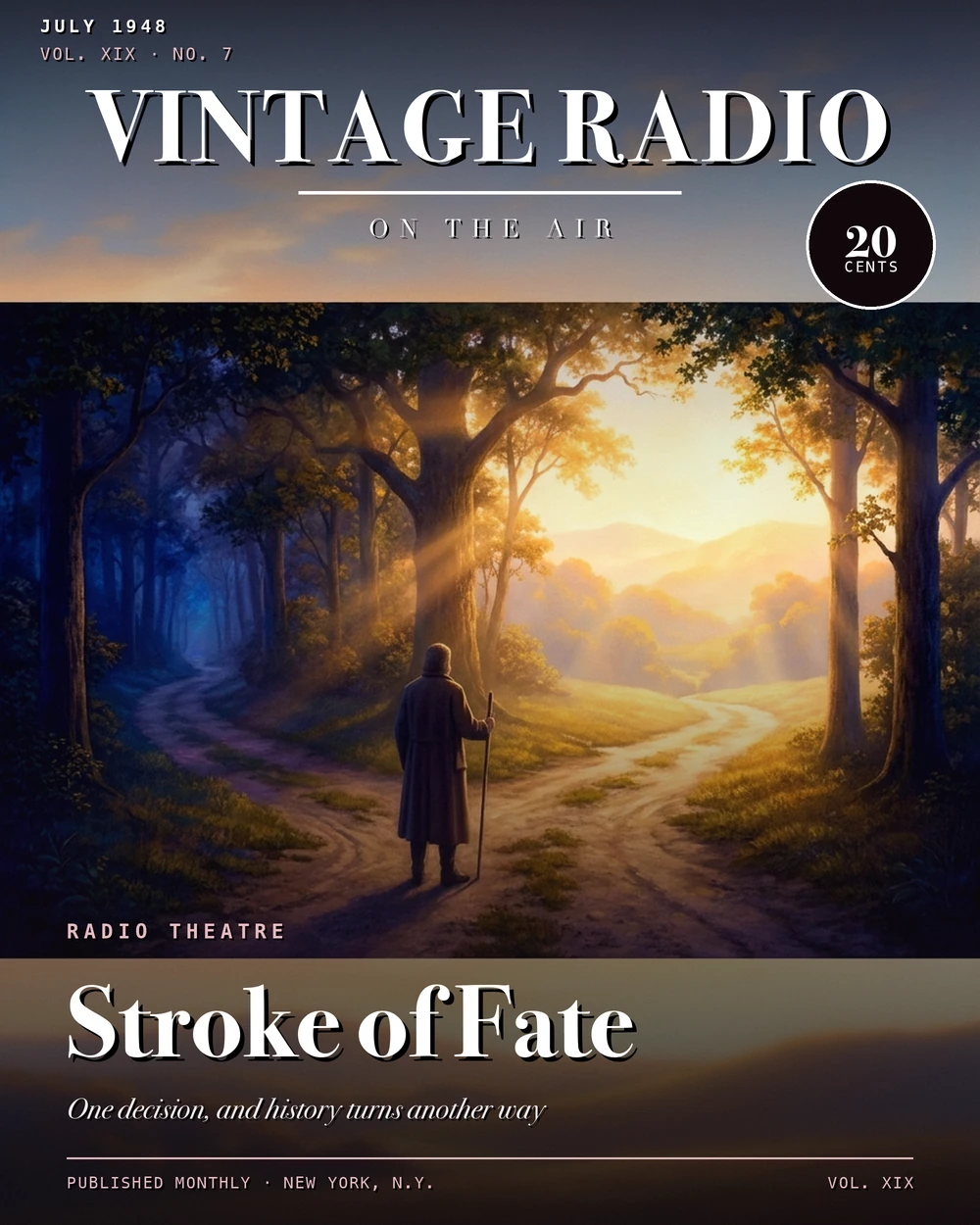
When NBC launched Stroke of Fate on October 4, 1953, it was stepping directly into territory CBS had already staked out with You Are There. The difference — and it was a meaningful one — was the premise. Where You Are There dropped reporters into actual historical moments, Stroke of Fate went a step further and asked what might have happened if history had gone the other way. What if Robert E. Lee had accepted command of the Union Army instead of returning south? What if Aaron Burr had been shot dead in his duel with Alexander Hamilton, rather than Hamilton? What if Alexander the Great had survived his illness in 323 BCE and kept marching east? That speculative engine was the entire point of the show.
The series ran on Sundays at 8 p.m. Eastern, 30 minutes per episode, for exactly 13 weeks. Producers Mort Lewis and Lester Lewis, working with director Fred Weihe, put the show together in New York and enlisted an impressive bench of historians to keep the speculation grounded. The Society of American Historians gave its formal backing to the production, and two principal consultants shaped the approach: Allan Nevins, the DeWitt Clinton Professor of History at Columbia University and a two-time Pulitzer Prize winner who had co-founded the Society of American Historians in 1939, and Stefan Lorant, the Hungarian-born editor and photojournalism pioneer who had been imprisoned by Hitler in 1933 before building a second career publishing illustrated pictorial histories of American presidents. Pairing two advisors of such different professional backgrounds — a scholarly historian and a visual journalist — was a distinctive choice for the series. Beyond Nevins and Lorant, Richard B. Morris, Gordon Craig, Moses Hadas, and James Thomas Flexner were also among the historians lending active support to the production.
The Stories It Told
The thirteen episodes ranged widely across history. The premiere explored what might have happened if Lee had taken General Winfield Scott's offer and led the Union forces at the start of the Civil War. A later episode put Julius Caesar and Cleopatra VII at the altar in 50 BCE. Another asked whether France could have stopped Hitler's occupation of the Rhineland in 1936 by meeting it with military force. The Alexander the Great episode, airing December 13, imagined the young Macedonian king surviving his illness and continuing his conquest of Asia. One episode revisited the Burr-Hamilton duel with the outcome reversed; another asked what would have followed if Abraham Lincoln had gotten the job he sought in 1841; a November 8 broadcast imagined Benedict Arnold's plot to betray America succeeding.
A few of the episodes tried more technically specific counterfactuals. Episode 12 centered on David Bushnell's Revolutionary War submarine, the Turtle — a one-man vessel that was the first submarine used in naval combat — imagining a scenario in which it succeeded in sinking British ships. The Alaska episode, airing December 6, took an unusual structural approach: it followed historical reality for the first 18 minutes before pivoting into speculation about what might have followed if Russia had declined to sell Alaska to the United States in 1867. The final episode, broadcast December 27, asked what England might look like today if the Norman Conquest of 1066 had failed.
Writers Mort Lewis and George H. Faulkner worked through these scenarios with the historians' input. Whether that collaboration produced strong drama was a matter of debate at the time — and not everyone came down on the same side.
The Cast and Crew
The show drew its cast from the pool of New York radio actors who worked steadily across NBC productions during the early 1950s. Listeners familiar with other NBC New York anthologies — including the science fiction series X Minus One — would have recognized many of these voices. Alexander Scourby, Anne Seymour, Patricia Wheel, Santos Ortega, Edgar Stehli, Ed Begley, and Hal Studer all took on anthology roles across the run, with Lionel Ricco serving as announcer. Host and narrator Walter Kiernan — a print journalist and radio commentator with the International News Service who would go on to co-host NBC Radio's Monitor from 1955 to 1960 — gave the series its through-line presence.
Scourby was, at the time, at an interesting crossroads in his career. Born in Brooklyn to Greek immigrant parents, he had trained in Shakespearean roles in the 1930s and built a reputation on radio through the 1940s. The same year he appeared on Stroke of Fate, he played ruthless mob boss Mike Lagana in Fritz Lang's The Big Heat. He later recorded 422 audiobooks for the blind — work he considered his most significant contribution — and his employment diaries covering twelve years of radio work are held at the New York Public Library's Billy Rose Theatre Division. Ed Begley, another fixture of New York radio through the 1940s and 1950s, would go on to win the Academy Award for Best Supporting Actor for his role in Sweet Bird of Youth in 1962.
How It Sounded
The production borrowed at least one technique directly from its CBS rival: an echo chamber effect applied to the announcer's voice, giving historical narration a quality of distance or solemnity. The theme music chosen to open each episode was Richard Strauss's Also Sprach Zarathustra — a piece that would become far more widely known fifteen years later when Stanley Kubrick used it in 2001: A Space Odyssey, but which Stroke of Fate was already deploying as an opening signature in 1953.
How It Was Received
Early listener response was reportedly positive. Billboard praised both the premise and the execution. But critical reception was not uniform, and sentiment shifted over the course of the run. Broadcasting magazine, reviewing the series in January 1954, argued that the historians had exercised too much influence over the scripts, producing dramas that were dramatically inert — the review described the results as "devoid of artistic merit." The competing assessments captured a real tension in the show's design: the same historical rigor that gave the counterfactuals credibility may have worked against the storytelling.
The broader problem may have been structural. You Are There worked because it placed audiences inside events that actually happened — the tension was already built in. Stroke of Fate had to generate its own dramatic stakes from scratch, speculating forward from a changed premise, which is a harder narrative problem. History, it turned out, proved more interesting when real than when imagined — not a dismissal of the show's ambition, but a pointer at the gap between a clever format and a fully realized one.
Producers had hoped the show would follow the same arc as You Are There, which had moved from radio to television in 1953 — the same year NBC launched its own historical drama format. That television version never materialized. The series ended after its 13-week run without renewal.
What Survives
All 13 episodes of Stroke of Fate are confirmed to survive. A maintained set documenting the complete run was issued in April 2022. The thirteen weeks stretch from the Robert E. Lee premiere on October 4 through the Norman Conquest finale on December 27, covering counterfactuals drawn from ancient history, medieval Europe, the American Revolution, the Civil War era, and the twentieth century. It's a short run — just over three months on Sunday nights — but the range of historical ground the show attempted to cover in that time was genuinely wide.